

Quest's Hand Tracking 2.4 update significantly improves the Fast Motion Mode, better handling rapid movements like punching and swinging.
Since launching controller-free hand tracking as a software update for the original Oculus Quest experimentally in late 2019 and publicly in early 2020, Meta has continued to improve the feature, gradually bridging much of the tracking quality difference compared to controllers.
- Hand Tracking 2.0 in 2022 brought improvements to handling fast movements, occlusion, and touching your hands together.
- Hand Tracking 2.1 in early 2023 reduced tracking loss and the time to re-acquire hands after loss, as well as improving the accuracy of prediction for fast motion.
- Hand Tracking 2.2 in mid 2023 reduced the latency of hand tracking, with Meta claiming up to 40% reduction in typical usage and up to 75% during fast movement.
- Hand Tracking 2.3 last year brought enhanced stability, improved accuracy, and even lower latency.
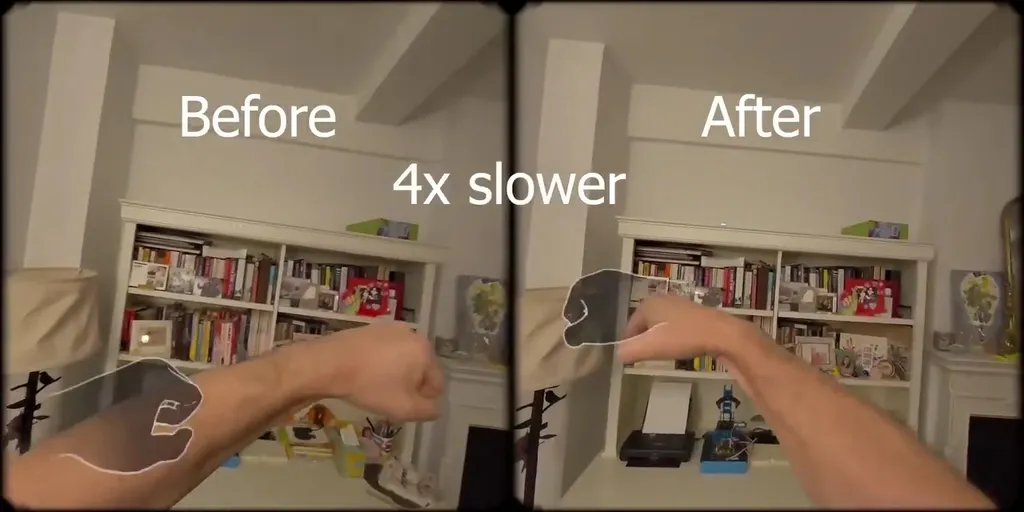
Comparison of Fast Motion Mode with 2.3 (left) and 2.4 (right).
Normally, Quest's hand tracking samples the tracking cameras at 30Hz. Optionally, the developers of apps can enable Fast Motion Mode, which makes the cameras sample at 50Hz or 60Hz, depending on your country's mains electricity frequency, to sync up with artificial lighting.
The higher sampling rate of Fast Motion Mode improves the tracking of fast motions, with the tradeoff of introducing some jitter that can make hand tracking feel slightly less accurate. Fast Motion Mode also requires brighter room lighting on headsets older than Quest 3S, because the camera exposure is lower, bringing less light, so without IR illuminators this will cause the tracking to degrade more.
Fast Motion Mode also cannot be used alongside simultaneous hands and controllers mode, and can only be combined with inside-out body tracking in VR, not passthrough mixed reality. Further, on Quest Pro, Fast Motion Mode can't be used alongside eye tracking or face tracking.
Still, these tradeoffs aside, Fast Motion Mode is ideal for fast-paced immersive games, and that's what Hand Tracking 2.4 is focused on improving.
 David Heaney
Meta says that Hand Tracking 2.4 arrived in Horizon OS v83, which started rolling out last month.
According to Meta, Hands 2.4 brings the following improvements to Fast Motion Mode:
- Faster Hand Acquisition: "Hands are detected faster when re-entering view. This reduces the 'hand loss' feeling during fast movements."
- Advanced Motion Upsampling: "Smooths out rapid gestures so motion appears continuous instead of choppy while minimizing motion artifacts."
- Optimized Fast Motion Filters: "Helps eliminate perceived latency between hand tracking and controller input during high-energy interactions."
Again though, keep in mind that Fast Motion Mode is a feature developers need to enable for their apps, so you'll only see this in games that chose to use it.
You should be able to test it out in Meta's free demo app from 2023 called Move Fast, which is designed to showcase how hand tracking can be used for immersive fitness games.