


The Khronos Group is aiming to standardize Gaussian splatting by proposing a release candidate for an integration into the widely adopted glTF 3D format.
Khronos is a non-profit industry consortium that manages OpenGL, Vulkan, and WebGL. In the context of XR specifically, it pioneered OpenXR, an open industry-standard API for XR application development and runtimes. OpenXR provides developers with access to a single standardized API, allowing them to build an app once and then easily port it to other platforms, facilitating cross-platform availability. OpenXR is supported by most major stakeholders in the XR industry, including Meta, Valve, HTC, ByteDance, Epic Games, Unity, Nvidia, and Qualcomm. A notable exception is Apple, which maintains its own proprietary APIs.
In 2015, Khronos introduced glTF (Graphics Language Transmission Format), a standard for the efficient transmission and loading of 3D scenes and models by game engines and applications. Often framed as the “JPEG of 3D,” it provides a streamlined, universal format that allows creators to export high-quality 3D assets from any tool while ensuring consumers can view them instantly and consistently across any device or web browser. Today, glTF is the most widely adopted 3D asset format on the web.
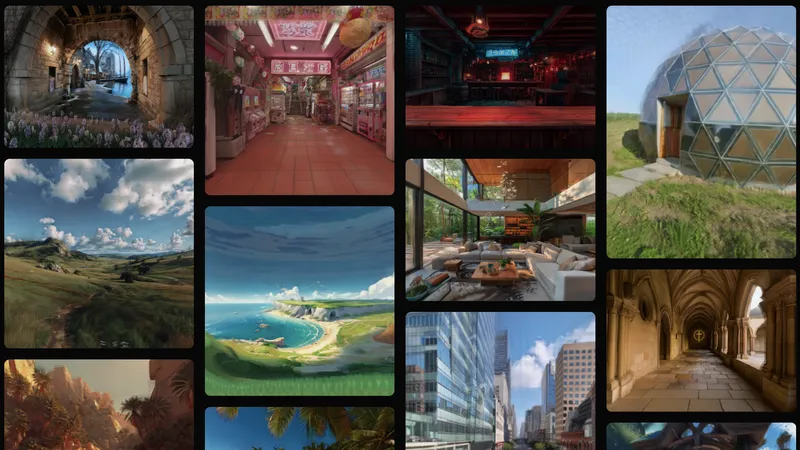
This week, Khronos announced a release candidate for a Gaussian splatting extension to glTF. Gaussian splatting has shown immense potential for XR, as it allows for quick and easy photorealistic 3D capturing of objects and environments using common devices like smartphones, which can later be viewed and explored in VR. The technology already powers the photorealistic captures of Meta Hyperscape, Apple’s recently improved Personas, the volumetric scenes of Gracia and the promptable 3D environments of Marble.
Standardizing Delivery: Why glTF Is Key To Mainstream Adoption
While capturing Gaussian splats has become easier, sharing them remains the primary hurdle, an issue Khronos is now directly addressing. The new glTF extension enables the storage of 3D Gaussian splats directly within glTF files. By doing so, Khronos is standardizing the delivery of Gaussian splats within an already established and widely adopted 3D ecosystem, paving the way for the technology to move into the mainstream.
“Instagram made it easy to share photos; TikTok brought about an explosion in short-form video social sharing. Until now, 3D has lagged behind 2D media formats because 3D models are so much harder than photos or videos to create and share. With Gaussian splatting, you can easily imagine an app that enables a mobile user to move their phone to quickly capture a scene or object to create a splat-based 3D model. As an open standard, glTF makes it possible to share that model. A splat stored in a glTF file could be shared on social media and displayed with full interactivity on any client device,” explains Neil Trevett, president of Khronos, in a written statement to UploadVR.
Khronos’s decision to formally embrace Gaussian splatting sends a clear message that lifelike 3D is here to stay, says Michael Rubloff, Managing Editor of Radiance Fields, a news blog specialized in Gaussian splatting and similar technologies.
“With that level of impact approaching, it becomes critical to build the foundations carefully. A glTF extension, built on the most widely adopted 3D asset format, helps derisk fragmentation as industries shift from 2D to 3D while giving developers confidence that what they build today can ship across ecosystems rather than remain locked to a single platform,” says Rubloff.
Gaussian Splatting: A New Form Of 3D Graphics Representation
Gaussian splats represent a fundamental departure from traditional mesh-based graphics. While standard 3D modeling relies on connected triangles to define an object’s surface, Gaussian splatting treats a scene as a dense cloud of volumetric data points, with each point defined by properties including position, scale, rotation, color, and opacity. The benefits over traditional 3D graphics rendering include the ability to capture complex geometries like hair or smoke and highly realistic lighting effects, such as reflections and refractions, that are notoriously difficult to achieve with polygonal meshes.
The new glTF extension acts like an instruction manual, telling the software to render these points as smooth, overlapping shapes, creating a realistic 3D image rather than the flat, jagged surfaces usually seen in video games.
Still, there is work to be done. The extension is currently in a release candidate phase, with the Khronos 3D Formats Working Group inviting feedback from engine developers, creators, and artists to test the specification ahead of a formal ratification targeted for the second quarter of 2026. So far, companies such as Autodesk, Bentley Systems, Huawei, Niantic Spatial, and Nvidia have contributed to the extension.
The release candidate was developed with the rapid and ongoing evolution of Gaussian splatting in mind. For example, it does not yet define a standard compression approach, which is crucial for making Gaussian splatting performant on mobile devices. To maintain flexibility, the specification is intentionally designed to be extensible, leaving room for future additions as Gaussian splatting techniques evolve and eventually become standardized within the glTF ecosystem.