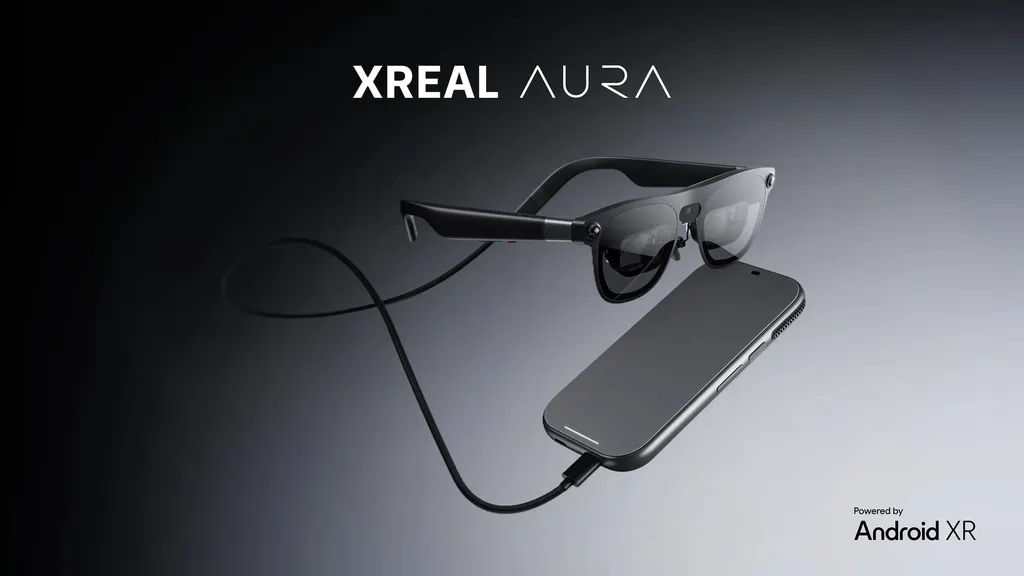
You can now preorder Xreal Aura, launching this fall, and the company confirmed it has Qualcomm's new Snapdragon Reality Elite in its Android XR puck. Yet despite opening preorders, Xreal won't reveal the price.
First teased as "Project Aura" just over a year ago, Xreal Aura will be the second device to run Google's Android XR operating system.
 David Heaney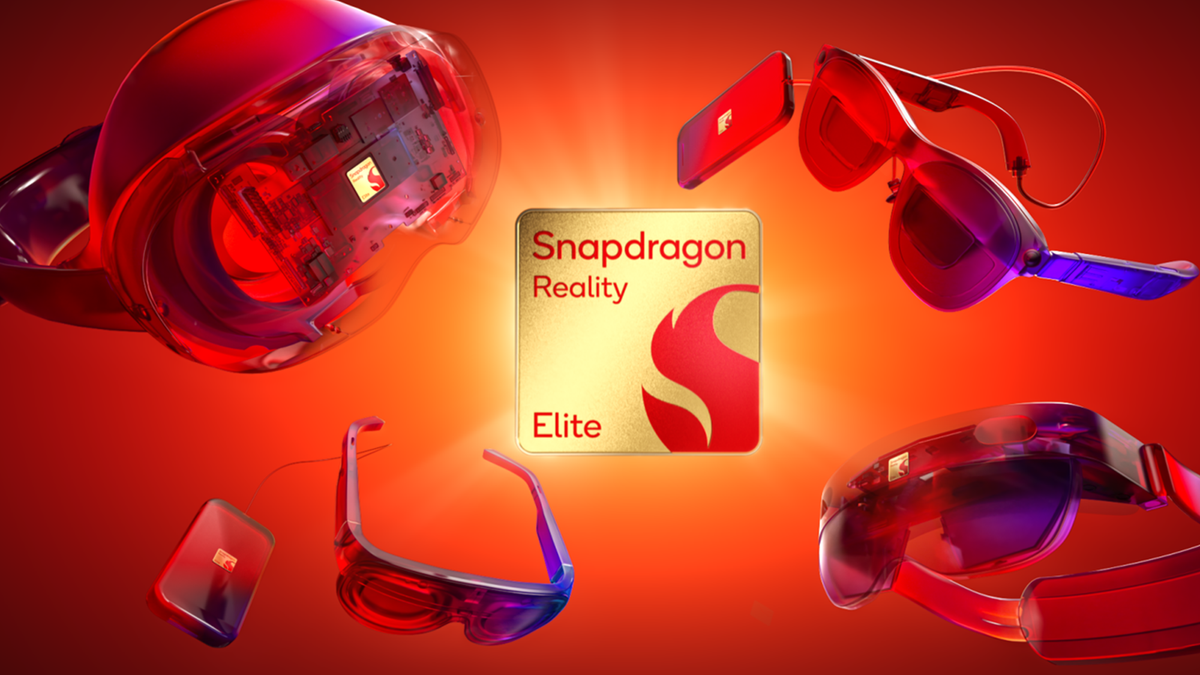
It's a prism-lens see-through device in a form factor that tries to imitate the basic appearance of sunglasses, as with Xreal's existing products. Though while Xreal's current products primarily act as a tethered virtual monitor for your existing devices, Aura comes with a tethered compute puck, running Google's Android XR on Qualcomm's new Snapdragon Reality Elite chipset, which it will be the first device to use. Last year, Xreal told some outlets that the puck would use the XR2+ Gen 2, but either that was a mistake or the plans have changed.
The Reality Elite in the puck is paired with Xreal's own X1S chip in the headset itself, which handles core computer vision tasks to avoid the enormous bandwidth requirement of transmitting the camera data to the puck.
Xreal says Aura has a field of view of 70 degrees diagonal, its widest yet, and has built-in head and hand tracking.
Most features and apps available on Samsung Galaxy XR will also run on Xreal Aura's puck, with some notable exceptions such as the face-tracked Likeness realistic avatars, as Aura doesn't have face tracking.
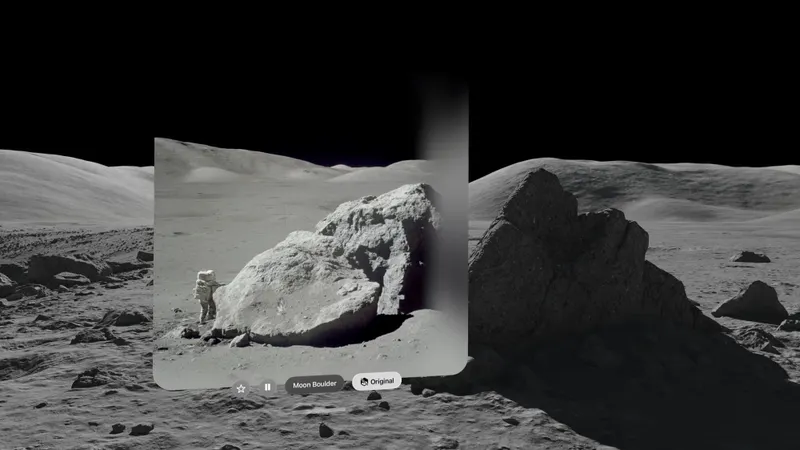
Footage of Xreal Aura in use from December.
Note that while Xreal devices are designed to look like sunglasses, they sit much further out from your eyes than real glasses, and thus are a markedly different device category than the true AR glasses of the kind Snap just opened preorders for.
True AR glasses like Specs use a display technology called waveguides to sit as close to your eyes as regular glasses, while Xreal uses a far cheaper but also far bulkier optical approach. They also block out most light, so can't be used as regular indoor prescription glasses.
Essentially, you can think of Xreal Aura as a lightweight alternative to Samsung Galaxy XR that trades off field of view and opacity for sleekness, rather than competition for future outdoor AR glasses.
Xreal says the glasses part of Aura weighs 95 grams.

You can now preorder Xreal Aura, and it will ship later this year. Though Xreal is using one of the strangest "preordering" systems we've ever seen.
The company is not yet announcing the price, nor many of the key specifications, other than to say that it will "not exceed $1500".
You can either pay $299 for a "Founder Priority Pass" or $99 for a "Launch Credit".
The $299 Founder Priority Pass, Xreal says, gives you "guaranteed earliest-batch delivery in supported launch regions", and "your unique, exclusive limited-edition number permanently printed on the product". The deposit will then be applied to the price of the product, so you'll only need to pay the difference.
The $99 Launch Credit meanwhile, still gives you an earlier shipping position than general sale, and actually doubles up, such that you get a net $100 discount on the total price you pay.
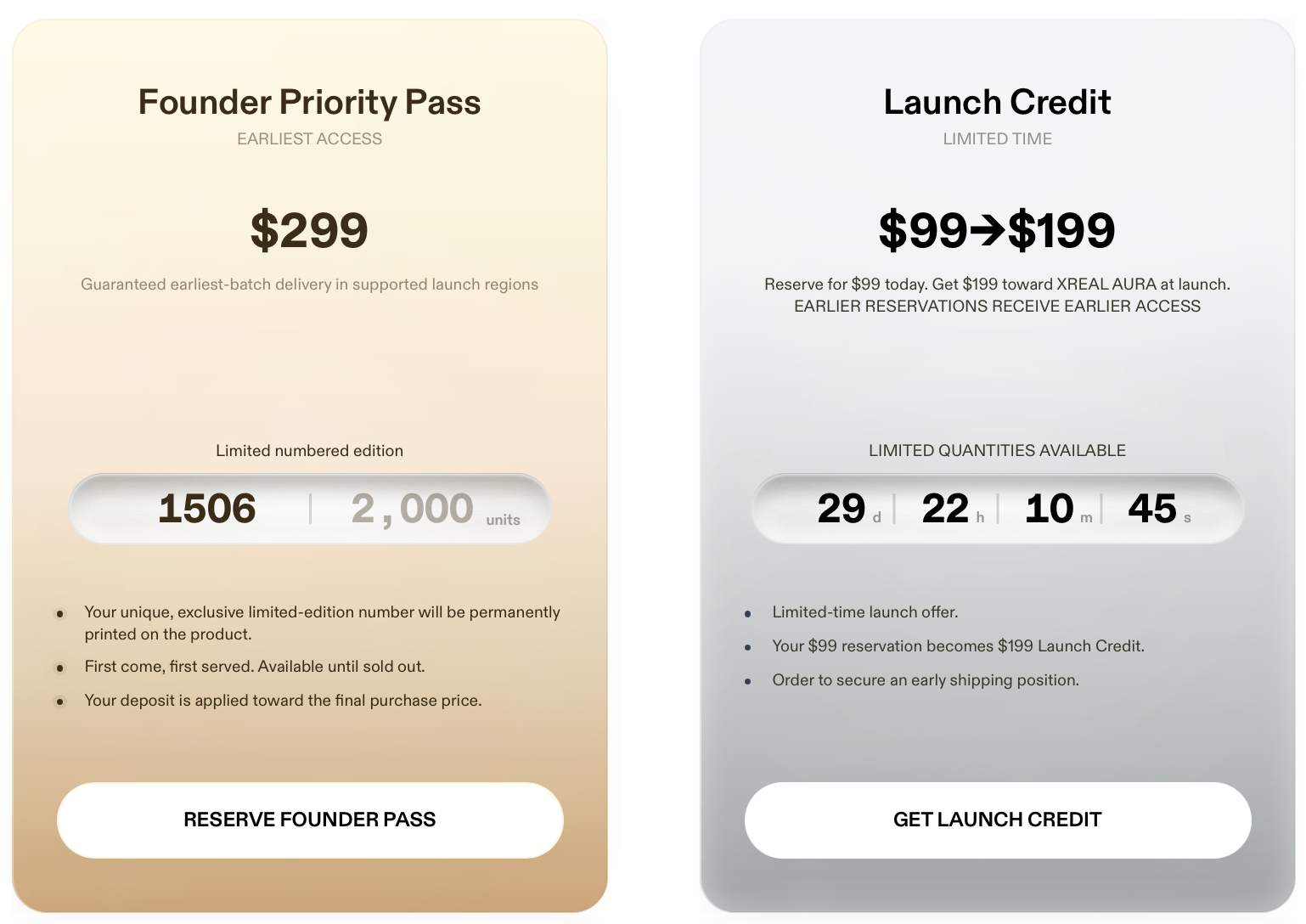
Xreal says the reservations are fully refundable before the final sale decision.