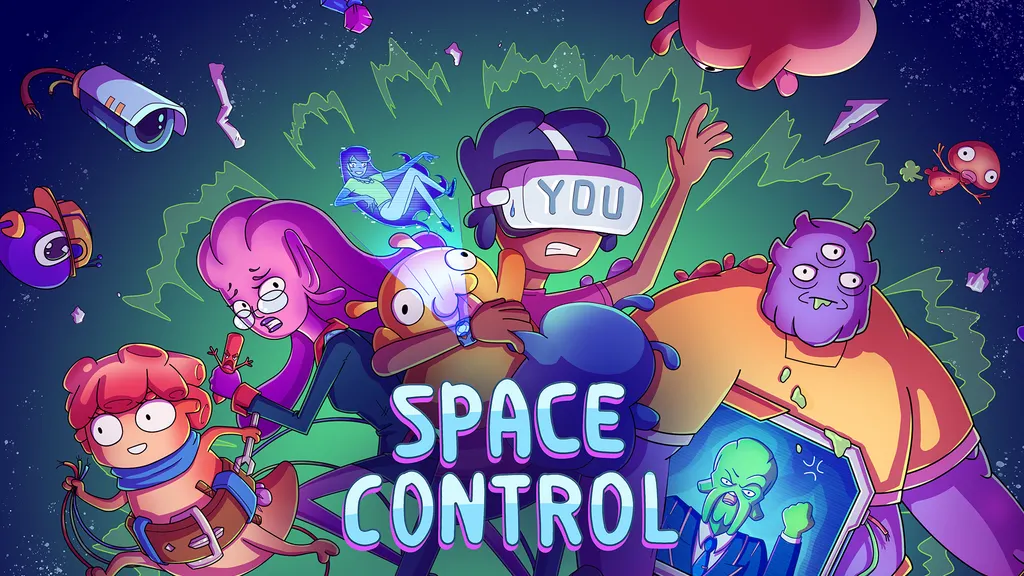
Space Control is an episodic, interactive VR space comedy available now on both Quest and Steam, courtesy of developer MoonMonster Studios.
As a concept, Space Control is instantly intriguing: a part-game, part-animated series inspired by the irreverent tone of Rick and Morty and Futurama. On paper, that sounds like a fantastic fit for VR. A comedic space adventure where you can physically interact with the world around you while a story unfolds has all the ingredients for something genuinely fresh.
Unfortunately, while the premise is good, the actual delivery falls well short of its potential.
Welcome to Glorpo
Space Control is structured like an interactive cartoon series. The 'game' includes three episodes, each roughly an hour long, that follow a ragtag crew of interstellar oddballs as they work off their debt to a sinister corporation called Glorpo Inc.
The setup is preposterous enough to work. You play an unnamed human (referred to as “Newbie”) who has been inadvertently abducted by Glorpo as part of a shady debt collection scheme, in which indebted aliens are forcibly recruited into indentured service. Despite being harvested from a planet designated as “just for laughs”, Glorpo’s strict no-refund policy means that like it or not, you’re stuck.
It’s a funny enough hook and one that immediately sets the tone for the game’s blend of sci-fi absurdity and workplace satire. You’re quickly assigned to Crew 68, a group of lovable weirdos that includes Melody, the highly strung team leader; Zorgle, a giant softie with more heart than brains; and Widget, a wisecracking engineer-slug who easily emerges as the standout personality of the bunch.
As a setup for an episodic comedy, it’s a reasonable start.
In Space, No One Can Hear You Fart
The story begins in your crew quarters, where you spend time getting to know your new teammates while the game establishes its world and tone. From this point on you’re free to roam around and fiddle with the various novelty gadgets scattered throughout the various game environments.
At first, this is encouraging. There’s enough charm in the setting and enough visual gags in the environments to make poking around the area mildly entertaining. The problem is that there simply isn’t much meaningful interaction to be had. Most objects can be picked up, squeezed, whacked or moved around, but little else.
That quickly becomes a problem because Space Control asks you to spend a lot of time simply standing around while dialogue unfolds. If you happen to gel with the writing, that may be enough. But if you don’t (and I largely didn’t) then the game’s long passive stretches start to feel sluggish very quickly.
The writing clearly wants to channel the chaotic energy of Rick and Morty and Futurama, but it rarely lands with the same wit or nuance. Instead, much of the humor feels crass and oddly juvenile, despite (or perhaps because of) the adult content and language, with a surprising number of jokes revolving around bodily functions. Basically, be warned: there will be butts.
That creates a strange tonal mismatch. The writing is too infantile to consistently entertain adults, but too adult to recommend to younger players. By the time the credits rolled, I was left with one overriding question: who exactly is this game for?
Working Hard? Hardly Working...
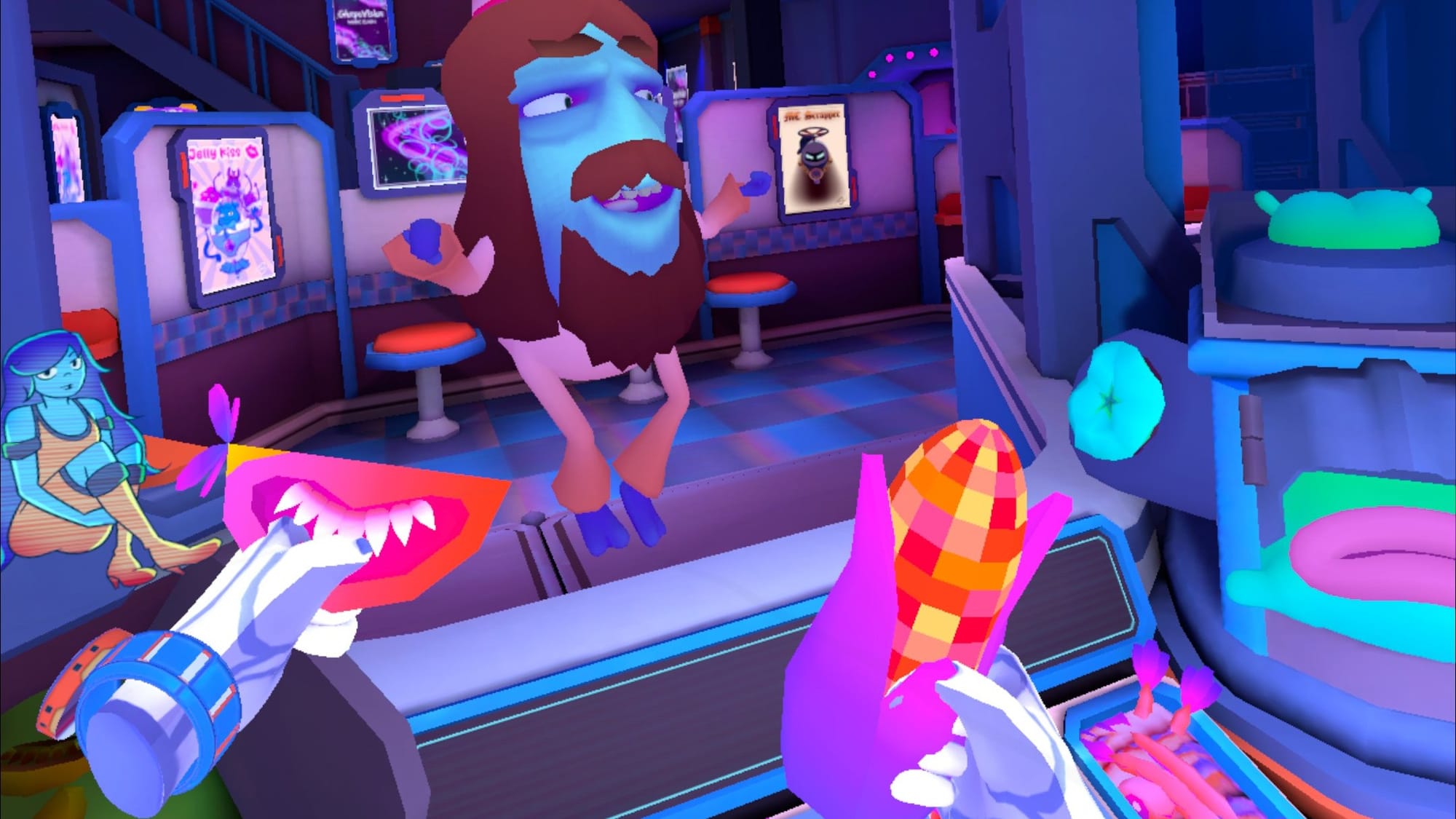
Once the introductory setup is complete, Space Control splits into three episodes, each built around a different job or scenario for Crew 68. These range from abducting new recruits to the Glorpo empire to operating an intergalactic daycare center, right through to concocting bizarre gaseous enhancements for performers at a Eurovision-inspired song contest.
Again, on paper, this all sounds great; whacky, irreverent premises that should allow for mad-cap adventures and amusing interactions.
The issue is that the gameplay underpinning these scenarios is extremely shallow. The trailers suggest something closer to a chaotic time-management game; fast-paced multitasking with over-the-top humor layered… over the top. In reality, what you get is a series of very basic, Job Simulator-lite interactions with no time pressure, no fail state and no meaningful sense of challenge.
You are essentially just repeating simple actions to trigger the next story beat.
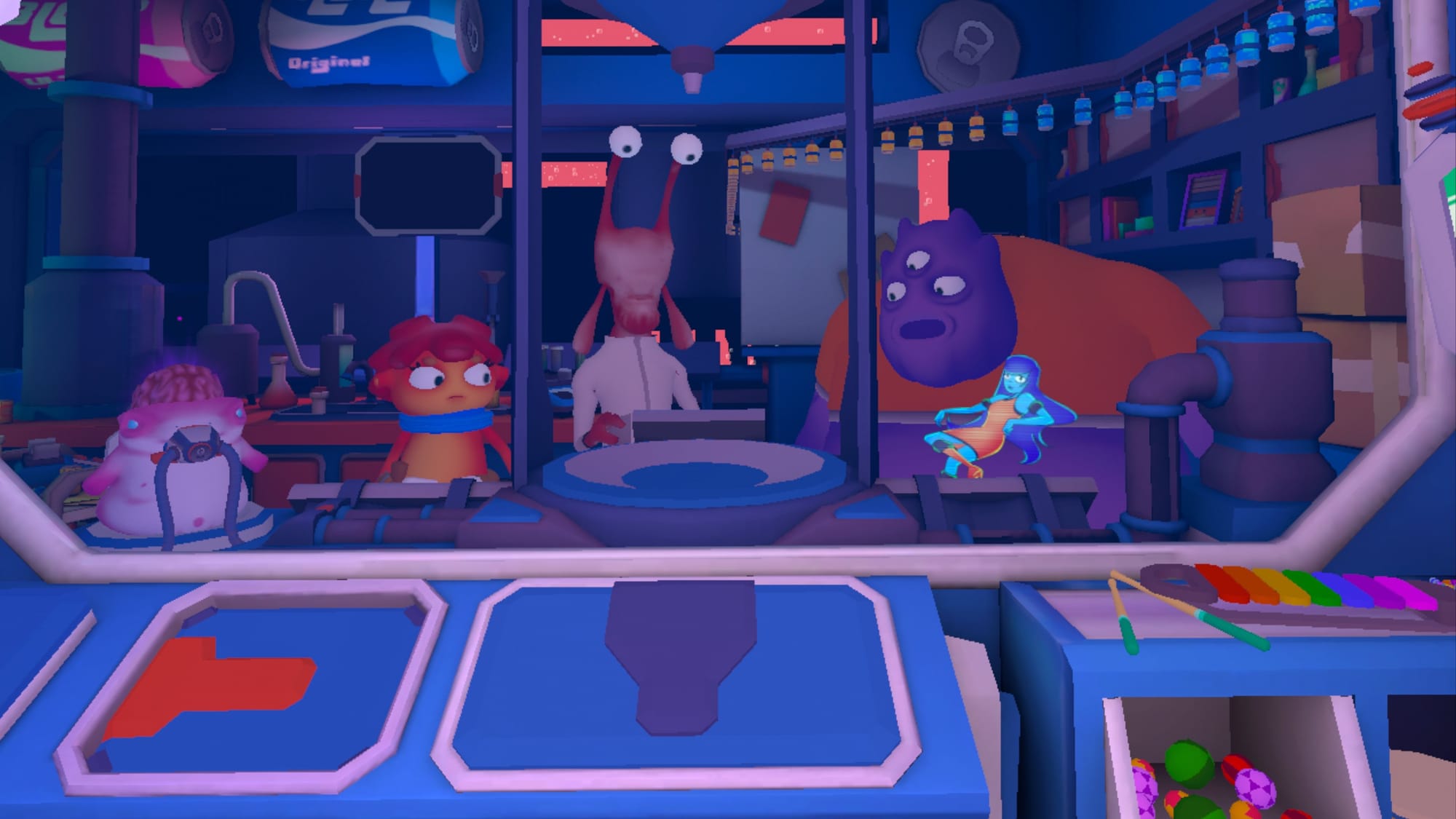
Take the first episode as an example. You’re tasked with retrieving new recruits using a claw machine-style grabber, dragging them around a processing station where you shave them, stamp them, and make sure their more sensitive areas are appropriately... investigated.
There’s an absurdity to the setup that should be funny. But the actual flow goes something like this: a few minutes of dialogue plays out, a control panel unlocks, you complete one simple task, another minute of dialogue follows until another task unlocks.
That rhythm, as well as the tasks that you perform in between dialogue, then repeats for about 20 minutes.
The result is that the interactive elements never feel meaningfully integrated into the experience. They don’t create tension, they don’t encourage experimentation, and they don’t really add much beyond giving your hands something to do while waiting for the next punchline.
More disappointing still, your actions have no bearing whatsoever on the story. There’s no room for creativity, alternative approaches or consequences based on how well you perform. The game simply pauses progression until you do the exact thing it wants you to do. That makes the whole experience feel oddly static and interactive only in the loosest possible sense.
This is perhaps Space Control’s biggest missed opportunity. Had these sequences been truly gamified - with real fail conditions, time pressure, or branching outcomes based on performance - there’s every chance this could have been a genuinely entertaining hybrid of narrative comedy and VR time management. The characters are engaging enough and the potential for pithy dialogue as you foul up a task under pressure would have been immense. Instead, the gameplay rarely rises above being vaguely functional.
That said, not everything falls flat. The final interactive segment, in which you [SPOILER] was a surprising amount of fun. It was the one point in the game where the interaction actually felt naturally tied to the scenario, and it was easily the highlight of the entire experience.
Comfort
Space Control contains all the comfort options one would expect from a fairly casual game. Roomscale, continuous stick-based and teleport locomotion options are all present, both smooth and snap turning, as well as vignetting all ensure that Space Control can be a comfortable experience.
Don't Quit Your Day Job
Visually, Space Control gets the job done without ever truly impressing.
The universe has a coherent visual identity, and there’s a certain charm to inhabiting what feels like an episode of an animated sci-fi show; artistically something that sits in the broad orbit of Final Space. There is also a decent physics system in place. Being able to mess around with objects while dialogue unfolds helps inject some mild engagement into otherwise passive scenes.
Still, the game feels rough around the edges. There are small but noticeable technical blemishes, from clipping assets to awkward model interactions. These aren’t game-breaking, but in a game that is essentially an interactive animation, one would hope that the focus on the animation itself would have been a little better.
The sound design is perfectly serviceable. The voice cast actually do a commendable job with the material they’ve been given. For the most part they hit the tonal balance that an ensemble ‘show’ like this needs to hit, and the actors play off each other well enough within the limitations of the script. This is somewhat of a relief given how much weight their performances bear on the success of the experience.
Final Verdict
Space Control is an underwhelming experience, not least because the seeds of a genuinely cool VR concept are clearly there. The premise is decent, the setup works well enough and the idea of blending episodic animated storytelling with interactive VR gameplay feels like something that absolutely should work.
As a narrative comedy the writing lacks the sharpness and consistency needed to sustain so much passive listening, and as a game, the interactive elements are too limited and too consequence-free to feel genuinely engaging. Unfortunately, Space Control never fully commits to either side of that equation, and as a result fails to deliver on either.

UploadVR uses a 5-Star rating system for our game reviews – you can read a breakdown of each star rating in our review guidelines.


![Good Morning [Employee Name] VR Trailer Hints At An Unsettling Office Mystery](https://storage.ghost.io/c/2a/2f/2a2f38f0-4b71-407a-9c7e-18a9e2541980/content/images/size/w800/format/webp/2026/10/good-morning-employee-name-vr.jpg)






![Good Morning [Employee Name] VR Trailer Hints At An Unsettling Office Mystery](https://storage.ghost.io/c/2a/2f/2a2f38f0-4b71-407a-9c7e-18a9e2541980/content/images/size/w480/format/webp/2026/10/good-morning-employee-name-vr.jpg)