

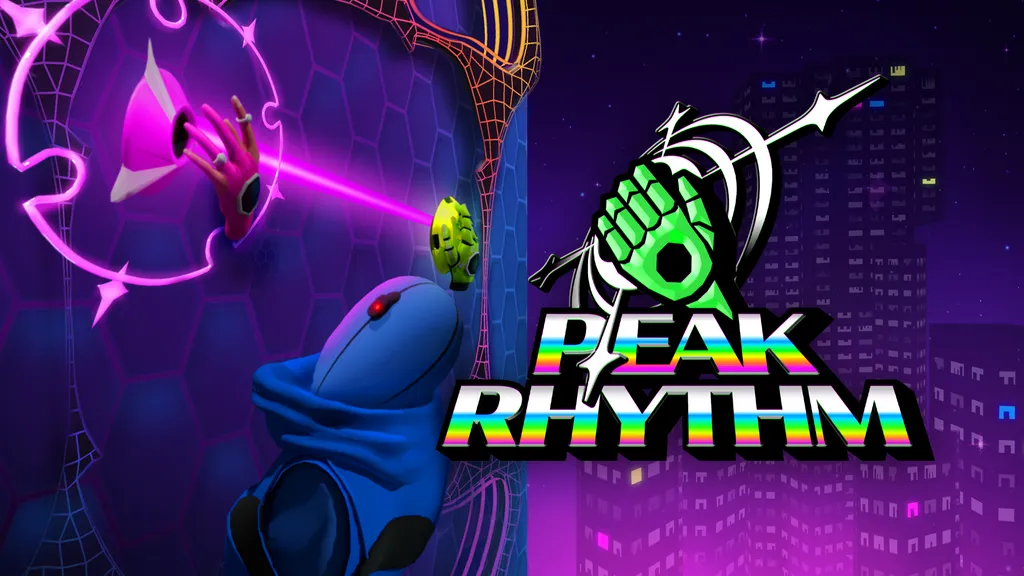
Launching in Early Access today on Quest, Peak Rhythm seeks to refresh the rhythm genre with pulse-pounding music set against a unique climbing mechanic.
To say I like Rhythm games is a cosmic understatement.
I've poured thousands of hours into the genre. I helped localize the English release of the Dreamcast cult classic Cool Cool Toon, and spent nine months hounding Masaya Matsuura, creator of PaRappa the Rapper, for an interview. When I had the opportunity to speak with Shawn Layden, former President of Sony Interactive Entertainment America, all we talked about was Vib Ribbon.
There's no other way to say it. I am obsessed with rhythm games.
So when I say that Peak Rhythm is a very good musical rhythm game, you've simply got to trust me.
What is it?: Musical rhythm game in VR, where you climb to the beat.
Platforms: Meta Quest (reviewed on Quest 3S)
Release Date: March 5, 2026
Developer: Zeitlos Interactive
Publisher: Impact Inked
Price: $12.99
It's the Climb
As is typical of many rhythm games, the gameplay hook behind Peak Rhythm is somewhat hard to describe. Despite the developers' somewhat obtuse explanation that Peak Rhythm is "a VR rhythm-climbing game where music drives momentum," I wasn't really sure what to expect. Once I'd spent a few minutes in the game, however, it all began to make sense.
The simplest way to describe Peak Rhythm is to say it's a game in which you climb in time with the music. You begin each stage standing face to face with a bare climbing wall, upon which handholds appear at various times and in various places. These handholds are color-coded, and surrounded by a ring which closes in time with elements of the game's music. The goal of Peak Rhythm is to grab the various handholds with the appropriate hand at exactly the right time (when the ring finishes closing).
Pink handholds are meant to be grabbed with your pink (left) hand, while green handholds are meant to be grabbed with your green (right) hand. Handholds may appear above, below, or to your sides, and on more advanced stages, reaching them may require complicated crossovers, leaps, or drops. Blue handholds can be grabbed with either hand, and it's important to be mindful of what handhold is coming next, after the blue one, so that you have the appropriate hand available when needed.
Grabbing a handhold with the wrong hand or with criminally poor timing will cause you to fall off the climbing wall onto a platform that follows closely beneath (think of it as a rope that doesn't allow you to fall too far). When this happens, you have to scramble your way back up the wall and grab the next available handhold. The music never stops, so getting back into the groove as quickly as possible is important.
Special handholds also exist to spice things up. There's a twist mechanic, in which certain handholds require rotation in time with the music. It's an interesting wrinkle that feels much better in practice than I expected.
The goal of each stage is to grab the handholds at the right time with the correct hand, to scramble yourself along the wall in time with the music. The better you do, the higher you climb in both the game world and on the game's leaderboards.
More Than a Feeling
With music and rhythm games, especially in VR, it's all about feeling. How does the game make you feel? Does the action match with the rhythm? Do you feel like you're experiencing the music in a meaningful way, and does the gameplay support this?
When I saw Peak Rhythm's first gameplay trailer, I had doubts. I couldn't imagine how effectively what I was seeing would translate to a gameplay experience. To be honest, I thought it looked tiresome. By the end of my first climb, I realized I had been wrong.
Peak Rhythm's gameplay is tight and refined, distilled down to an essential core that feels perfect. The act of lifting and placing your hands to the beat of a song is intuitive and instantly rewarding. The songs are well-designed to complement the gameplay, which is intelligently balanced and consistently interesting. There's an intangible element here which exists in all of the best rhythm games, which allows you to ebb into and out of a sort of flow state, where the music and gameplay becomes so well-linked that playing the game feels the same as listening to a great album.
The built-in soundtrack features original tracks spanning several genres, including drum & bass, dubstep, and house, with tracks from FEISTLING, Killin' Void, Ion Diary, and funiel, and while I admittedly hadn't heard of these artists prior to my time with Peak Rhythm, their tunes are consistently great and the entire set list suits the game perfectly.
On top of all that, Peak Rhythm will get you moving. We're not talking about Beat Saber levels of activity, but you will burn a few calories, and that's at least a happy side-effect of playing a fun game.
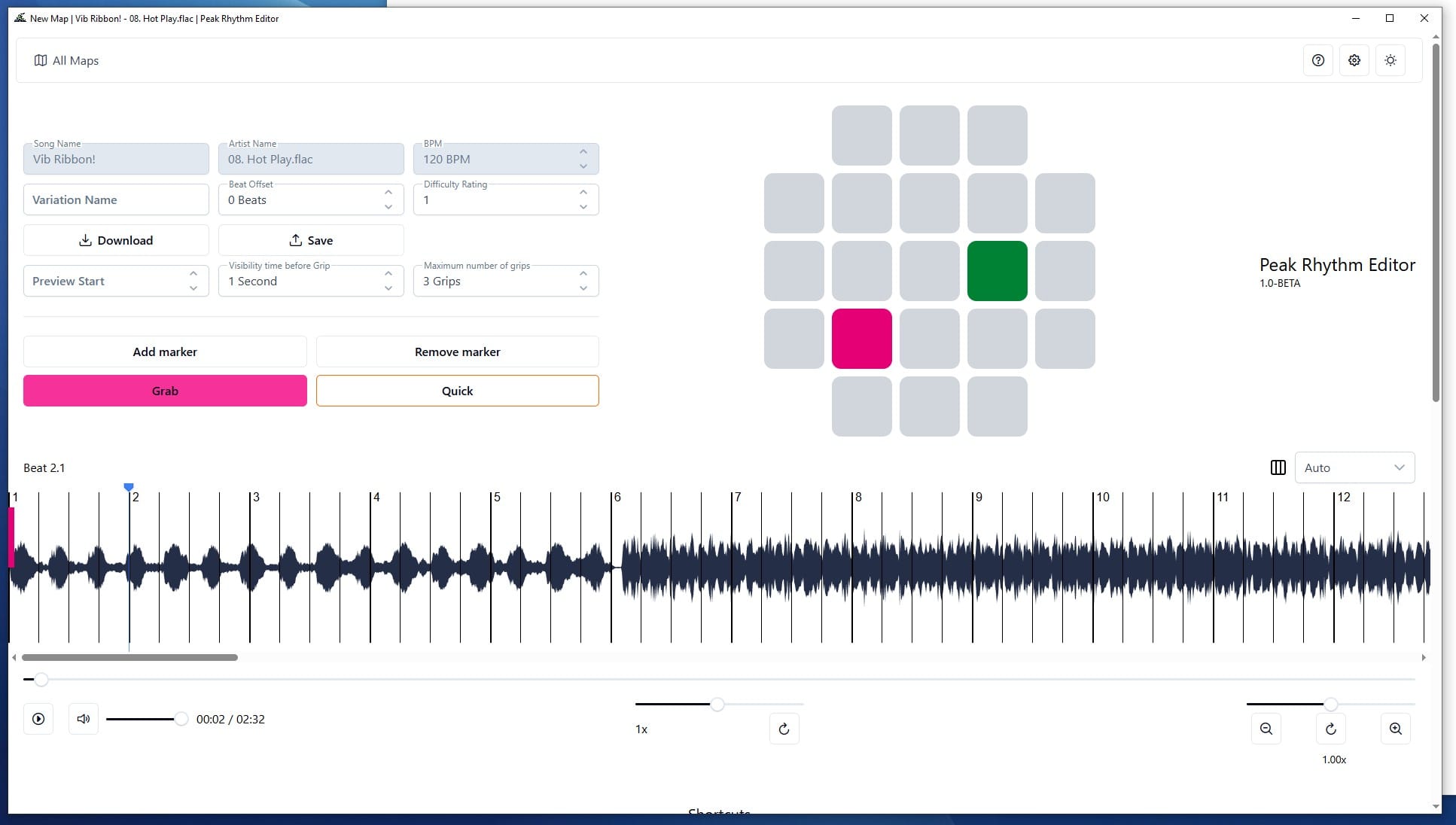
In addition to the game's native tracks, Zeitlos Interactive has also developed a beatmap editor with which users can create their own custom stages using their own music files.
This feature immediately puts me in mind of Sony's Vib Ribbon, which I previously mentioned, a PlayStation game released in 1999 that invented and patented a method for creating custom levels based on the audio files from any CD that the player might insert into the system. While that now-ancient PlayStation game could automatically generate levels from any music file on its own, Peak Rhythm's custom song system relies on human users to do the work of creating a beatmap and custom stage.
Still, user-generated content hypothetically gives the game near-infinite replayability, plus a sort of custom soundtrack perfectly suited to each players' unique taste.
The developers have let me know that "the custom song feature works through a standalone desktop app." And while this hasn't been published during my pre-release play period, I'm told it should be available at launch, and that a "work-in-progress version is currently circulating within Impact Labs (QA and playtesting)."
Comfort
Peak Rhythm is playable in sitting, standing, and room scale configuration. In addition, there are numerous options for audio levels, comfort, and accessibility, including input adjustments, and selectable offset for player height.
Trouble
All that said, no game is perfect and Peak Rhythm is no exception. The visuals are uninspired. While this graphical simplicity makes the rhythm gameplay more legible, I can't help but be disappointed by the general lack of visual interest present in the immediate environment, in the backgrounds, in the central starting hub and menus... essentially, everywhere.
We're supposed to be climbing a skyscraper at night. This should be the coolest looking thing I've ever seen. But as it exists today, it's bland.
And while the soundtrack is great, as mentioned, it's still quite limited. This can be forgiven, perhaps, on account of the game's Early Access status and its allowance for custom songs. But I'm reaching. There simply needs to be more music in this musical rhythm game.
Lastly, there's no multiplayer. While a multiplayer mode is planned for an upcoming update "shortly after launch," I can't review features that don't yet exist, nor do I know what shape the game's multiplayer will take. For now, the omission is a notable strike.
It's the End of the Review As We Know It (And I Feel Fine)
On balance, Peak Rhythm is a very good game, and with further development beyond its Early Access period, it could easily become a great one. The team's planned roadmap is ambitious. We'll just have to see how closely and quickly they stick to it.
After spending a few days scrambling up its skyscrapers, leaping, reaching, and scampering along with its eclectic (though limited) soundtrack thumping in my ears, Peak Rhythm feels like a favorite album, a game that I'll return to again and again.
Peak Rhythm is out now in Early Access on Quest for $12.99.

UploadVR uses a 5-Star rating system for our game reviews – you can read a breakdown of each star rating in our review guidelines.