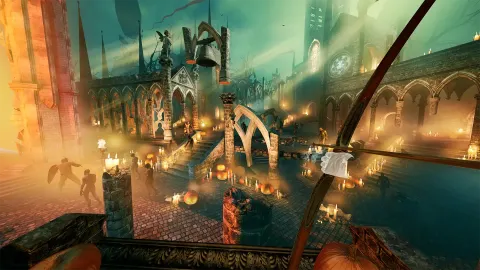
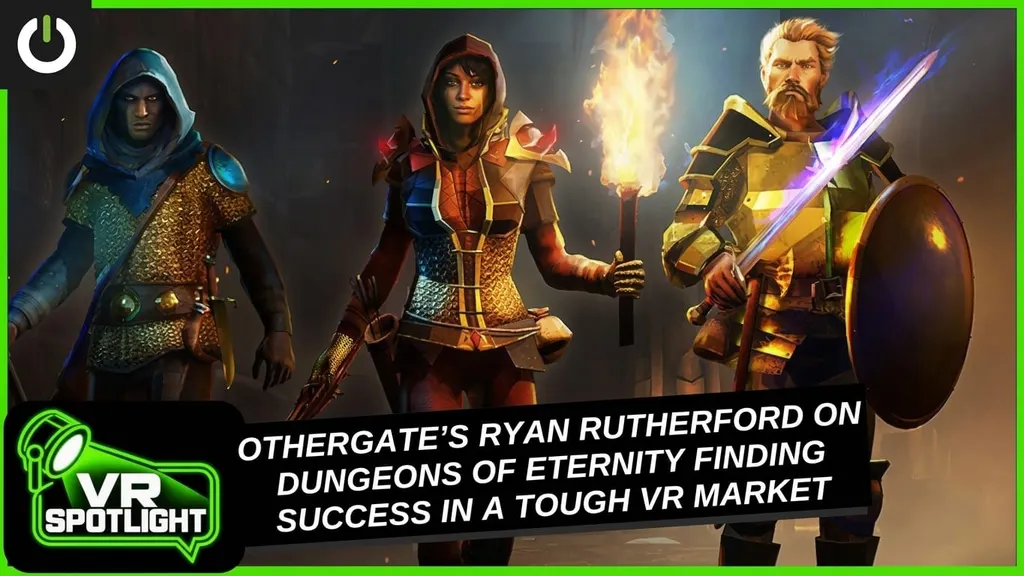
In the latest episode of VR Spotlight, UploadVR spoke with Othergate co-founder Ryan Rutherford about how co-op dungeon crawler Dungeons of Eternity has found sustainable success over three years in an evolving and challenging VR gaming market.
VR Spotlight is UploadVR's live interview series, which streams to YouTube from an in-VR virtual studio and syndicates to podcast platforms to bring audiences firsthand insights from the developers and creators building XR hardware and software every day. For this episode, UploadVR's Mike Johnson sat down with Rutherford to discuss the game's inspirations, dungeon modes, scaling to four-player co-op, Quest 2 and Quest 3 support, PlayStation VR2, Steam Frame, upcoming user-generated content and mod plans, and questions from the live audience.
If you prefer to listen on the go, VR Spotlight is also available as an audio podcast on Apple Podcasts and Spotify, or you can read the lightly edited transcript of the conversation below.
What Dungeons of Eternity Is and Its Inspirations
Mike Johnson (UploadVR):
“My guest today is Ryan Rutherford from Othergate. They are the developers behind Dungeons of Eternity. Ryan, thank you so much for taking the time for us today. How are you doing?”
Ryan Rutherford (Othergate):
“I'm doing well, Mike. Thanks for having me on.”
Mike Johnson (UploadVR):
“For people who don't know what Dungeons of Eternity is, I could tell you what Dungeons of Eternity is, but I've got the dev sitting right here, so why would I do that? Ryan, in your own words, what is Dungeons of Eternity?”
Ryan Rutherford (Othergate):
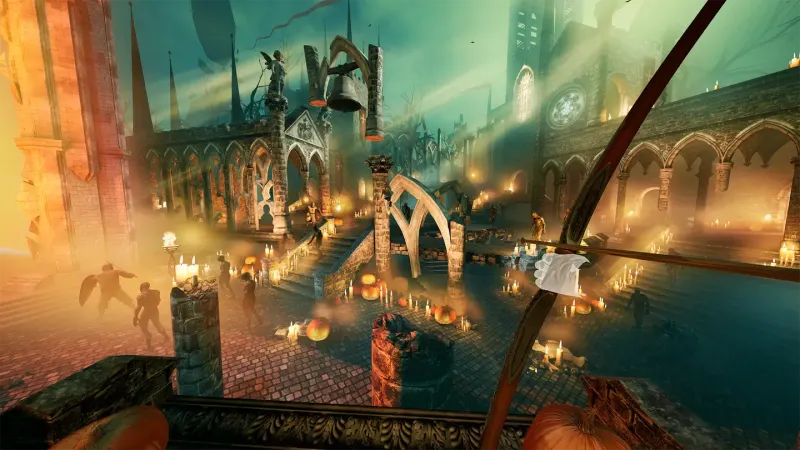
“At its heart, it's a four-player co-op dungeon crawler built for VR from the ground up. It's a classic hack-and-slash dungeon crawler. You run around through procedurally generated dungeons. No run is the same. It's great solo, and it goes all the way up to four players. You use a wide range of weapons—swords, bows, shields, magic weapons—collect loot, come back to your outpost, upgrade your characters, and rinse and repeat.
The game's been out now for over three years. We just had our three-year anniversary in October, and we've been providing free updates since launch and continue to add new enemies, new dungeons, new weapons, new game modes—just continue to build the game alongside the community and try and build it with them. So far, so good.”
Mike Johnson (UploadVR):
“When you and the rest of the team started working on this game, what were the primary inspirations for Dungeons? Because every game pulls from something that you played before. What were those inspirations?”
Ryan Rutherford (Othergate):
“There's a lot. I'd say at the heart of it, it's classic dungeon crawlers like Diablo, of course. And then for more of the dungeon design, you go room to room, so it's got this classic Zelda inspiration. By trade, I'm a level designer. Growing up, some of my favorite games were Zelda and other games in that genre. So this idea that you're going on an adventure with your friends—Zelda, we always come back to as the foundation of a lot of the exploration and the simplicity as well, and being able to assemble random dungeons through a bunch of different independent chambers that can be mixed and matched.
So there's a bit of familiarity when you go through the dungeons, but also each one feels a little bit different. You're not quite sure what's going to be through the next door. And then as we update, we're able to add more chambers to the whole set of chambers that we have in the game, and it continues to generate new dungeons each time we update the game.”
Mike Johnson (UploadVR):
“You mentioned Zelda, so I have to ask: have you played the new Ocarina of Time remake?”
Ryan Rutherford (Othergate):
“Absolutely. The new one is so good. I love the classic. I like all of them. Even Breath of the Wild is amazing, but the classic Zeldas with their dungeon design and getting new items and keys, it's just great to go back and see that same original classic Zelda still works in a modern-day game.”
Dungeon Modes, Player Metrics, and Scaling to Four-Player Co-Op
Mike Johnson (UploadVR):
“Up until recently, there were three main modes. Forgive me, I don't know the names of them—I know them by color. I always say the blue dungeons, the green dungeons, and the red dungeons were the ones that you pretty much started with. This year you added two on: there was Tomb Extraction, which we'll talk a little bit more in depth about later, and Stormgrave. But for the first couple of years, it was just those three. Did you play around with different dungeon types before you got to Tomb Extraction? Were there some that were just like, ‘This isn't really working, we're not going to put this out yet’?”
Ryan Rutherford (Othergate):
“Yes and no. Like you said, it sort of came about from having these dungeon rooms—these chambers in the dungeons that are all fully lit and everything, and then we have water areas and lava areas, and then you also have these really dark dungeons. So you walk in and it's pitch black, and you have to grab the torch and explore the dark dungeons, but we don't have any enemies in there. It's really just more of a pacing mechanic where you can go in and we slow the game down a little bit. And in co-op it's great because only one player could use the torch, so it becomes a more intimate experience.
We always thought that could be a really nice game mode in itself where we can play around with the pacing so it feels different than the red dungeons, which are Dungeon Raid—kind of the classic run through a dungeon, collect loot, come back. And then we have the two others, which are Soul Harvest, which is more of a horde mode, and Crystal Hunt, where you go off and collect these crystals and then come back to the hub. So the layout and the flow of the dungeons in each mode feels different. Tomb Extraction just came about from taking something that was already in the game and seeing if we could build more out of that and keep it separate from the other modes as well.
And yeah, we definitely played with other modes. We have another one that's called Sandbox, and we only have one arena in the game at the moment, but we plan to expand on that as well. That allows players to go in and just kind of go crazy and play with different weapons they may not have, or spawn endless waves of enemies that don't necessarily show up in those configurations in the dungeons, and turn on fun things like low gravity mode. That's sort of an experimental mode where we can kind of throw in new things without necessarily breaking the core mechanics of the rest of the game.”
Mike Johnson (UploadVR):
“Do you have internal metrics on which mode gets played the most?”
Ryan Rutherford (Othergate):
“Definitely.”
Mike Johnson (UploadVR):
“If you had to rank them in terms of player interest, how would you rank those?”
Ryan Rutherford (Othergate):
“Dungeon Raid is number one. And it makes sense. That's the one that has probably the most interesting dungeons you go through, and that's the one where you gotta find the keys, you get the loot, it always ends with a boss fight, and that's the one that players gravitate to. Those are the ones that you get the most gold and experience from as well. The other two modes, Crystal Hunt and Soul Harvest, provide different resources to help your character unlock new potions or unlock exo points, which allow you to basically add on buffs and what we call exo perks to your character. So there's reasons to play those, but in a way, once those are sort of extinguished and you've collected enough of those resources, people always come back to Dungeon Raid, as that's kind of the heart of the game.”
Mike Johnson (UploadVR):
“The game started at three-player co-op, right? Was the plan to always get to four eventually, or did you want to start with four and decide to start with three for performance reasons?”
Ryan Rutherford (Othergate):
“It's a good question. There's a bit of both. We're a small team—there's four co-founders, and then we have two other developers to help us full-time, so six full-time developers. Having to only get three of us in was actually really convenient. And the team is actually spread out across the world, so time zones play a part in production, and being able to just put in three was very helpful to that process.
And then for performance reasons, Quest 2 was the main platform at the time. We launched probably a week before Quest 3 came out. Along the way, ever since launch of that headset and the game, not only has Meta made improvements on their end to optimize performance for their headsets, but we've made internal improvements as well. We were able, once the game came out, to go back and optimize a bit. We always wanted to get to four, though three was also a sweet spot. But that was the number one request: ‘When can we get four?’ A lot of games have four players, of course, so people had to leave a person out of their squad on dungeon runs. That was a big push on our end to make that happen.”
Mike Johnson (UploadVR):
“Looking back on the original launch trailer now, three years later, is there stuff where you're like, ‘Ah, I remember when we did that’? You said you're the level designer, so are you thinking about when you built certain rooms?”
Ryan Rutherford (Othergate):
“It's funny to go back and watch this one, even the cuts of the players and everything. We worked with a studio called Scout House that helped us with this trailer, and I thought they did a really good job capturing the cooperative nature of the game and really showcasing that, because I do think that is the heart of the game. You can totally play the game solo, and we continue to keep that in mind when we build new features—like, ‘Well, what if someone's playing by themselves?’ But I think the game really shines when you play with other players, and even if you've played the dungeons a hundred or a thousand times, like some players, when you play with other players there's just that element of surprise, and usually humor comes out of it, and it makes for a really fun and exciting experience. So I'm glad the original trailer really captured that.”
Quest 2 Support and Building for Quest 3
Mike Johnson (UploadVR):
“Here's a great question in chat because I know you just talked about Quest 2. Old Brittle Bones—that's a fantastic name, by the way—asks: ‘Are there any plans to deprecate support for Quest 2 to get even more out of Quest 3 moving forward?’ Building off the fact that Meta just announced that Quest 2 and Quest Pro are going to go end of life at the end of 2027.”
Ryan Rutherford (Othergate):
“I think we'll support it as long as we can. We just had our Halloween update; before that, we did Tomb Extraction. When we launched the Steam version last year, we added graphical settings that you could tune, and then we brought a lot of those settings to the Quest platforms in that update. So for low-end devices, you can turn down a lot of things. We continue to try and make the game more optimal. It's not the biggest user base anymore. It's definitely going down, and it's probably the least used headset now for us. Quest 3 and then Steam Frame's doing pretty well right now, and we've been surprised and very excited about that. There's still a high enough percentage to keep support for it, though at some point those things might be out of our control. If Meta updates their OS and we can't support it, then that's not up to us.”
Mike Johnson (UploadVR):
“That's interesting that you said that because you hear all the time that there are more Quest 2s out there than any other headset, and you hear from the community about people still building for Quest 2 and that's why these games don't look any better. But you're starting to see that sea change, right? Of people moving on to the higher hardware. That's actually good because I think the industry needs to move forward with that.”
Ryan Rutherford (Othergate):
“Quest 3 is an amazing piece of hardware. It still surprises us sometimes what we're able to do, and then we're like, ‘Oh, we got to make it support Quest 2 as well,’ because there are still people playing on that, and it's important to still support it. So we will as long as we can.”
Mike Johnson (UploadVR):
“So when you roll out a new update, are you building for Quest 3 first and then making it work on Quest 2?”
Ryan Rutherford (Othergate):
“Quest 3 is pretty much the foundation. We start from there and then add features that allow players to tune down things for Quest 2, and then it works on PC, so we have PC mode as well on Steam. Quest 3 is sort of the main platform.”
Mike Johnson (UploadVR):
“You launched on Quest 2 right before Quest 3 came out. I've always wanted to ask this, because I thought about this when your game first launched: did you know when you were setting your release date months ahead of time that Quest 3 was expected to launch within a week of when you launched, or was that like, ‘Oh, a new headset's coming, great, we'll just roll with it’?”
Ryan Rutherford (Othergate):
“We did know. We have connections with Meta and they helped support the game and supported us in various ways. One of them was getting us early Quest 3 hardware and making sure we were ready. So we were well aware of it and did align with them. I think this was sort of before they opened up the store—it was still App Lab days, where if you had a game you could put it up on App Lab, but you couldn't be found in search. The next year they changed it so that anyone could release any game and it goes straight into search mixed with everything. So at that point it was a bit more of a curated store, and we worked closely with Meta to align on a release date that was around the time of the Quest 3 launch. It worked out really well for us because that was a very busy holiday season for VR, so it kind of got out before a huge rush of games.”
Mike Johnson (UploadVR):
“Did you have a dev kit already in-house—were you already working on the Quest 3 updates when the headset launched, or did that come later after launch?”
Ryan Rutherford (Othergate):
“That sort of came later. We had the Quest 3 just to make sure everything worked. We knew it was much more powerful than the Quest 2, but since Quest 2 was still what everyone had at the moment, we really had to tune everything to work for that, hence the three-player focus and things like that.”
Realms, Stormgrave Outdoor Areas, and Steam Cross-Play
Mike Johnson (UploadVR):
“Question from Endless Chaos, this one's kind of funny: ‘Was the Lava Forge combo of bombers, giant spiders, and blind octoculus intentional? You get tied up, blown up, and you can't hear your own teammates.’”
Ryan Rutherford (Othergate):
“Lava Forge is supposed to be one of the harder realms. In the game, now we have five realms, but the game launched with four: Underworld, Sandstorm, Vile Halls, and Lava Forge. And then this last update for Halloween, we made Stormgrave a permanent realm. They change the visuals, some of the environmental hazards, and of course the enemies and some of the drops are different. So Lava Forge is supposed to be the harder one. Talking about not being able to hear your teammates, that has been a bug for a while where the blind octoculus is so loud that you can't hear anything. I thought we fixed that, but maybe we didn't. In some way it's intentional, but also it can be obnoxious if you can't hear your teammates.”
Mike Johnson (UploadVR):
“It's not a bug, it's a feature! An enemy that can drown out everything would actually be a good idea because it's so co-op driven—isolating your character or muting everything would be nice. Endless Chaos followed up in chat and said, ‘Please never change it. It's so perfect for scary and panic-inducing.’
And then there's this one from Gene Loves VR: ‘The new outdoor spaces in Stormgrave are incredible. One space in particular feels almost like an open world. Will we get more outdoor arenas and larger areas like that? P.S. More to climb, please.’”
Ryan Rutherford (Othergate):
“Gene loves climbing anything in the game, and he's really good about finding all of the areas I haven't clipped off. But I'm glad that he and other players have voiced this as well. They've wanted more outdoor rooms for a while—you're usually in these dark dungeons and such. Internally, we have different sets of room styles. We have the buried set, which are more crypts, and then we have caves, of course, and keeps, which are more castle style. Then we added a new set for the Stormgrave update, and we call it the forest set. It's sort of a mix of mausoleums and graveyards plus giant redwood trees—these massive tree trunks extending up to the sky—which allows us to build these bigger outdoor areas, and they do feel a bit more open world. We are working on more rooms like that, so more of that will be coming for sure.”
Mike Johnson (UploadVR):
“As a level designer, was it freeing to be able to get out of the dungeons and do more outdoor arenas? Because Stormgrave was initially just a limited-time thing last year, right, and you made it permanent this year. Was it freeing to go, ‘Ah, I can see the sky now’?”
Ryan Rutherford (Othergate):
“Definitely. We have some outdoor rooms already, but they still feel walled in. There's a few reasons for that. One is just how the dungeons are assembled—they're room to room. So in some way, they can't overlap their bounds because they bunch up against other rooms. We can kind of get away with that sometimes, where having a vast vista out in the distance and then going down into a cave and the next area you're in something totally different that doesn't make sense isn't that big of a deal. We do have some space limitations, but we're figuring out other ways and building other tools internally to build more terrain and outdoor areas quicker, because the bigger they are, sometimes they can take a lot longer to build. So it is freeing, and I think players like the mix of going in and out.”
Mike Johnson (UploadVR):
“Is there a performance hit from going outside too? Let me ask this in a different way: is there one realm that's more performance-heavy than another?”
Ryan Rutherford (Othergate):
“Stormgrave would probably be the heaviest right now on the outdoor areas because we have weather out there. When you're outdoors in Stormgrave, it's raining and we have lightning in the distance. Then we have another realm that's temporary every Christmas time called Frostbound, and instead of rain we do snow, ice puddles, and frozen surfaces, so things are slippery. Those outdoor areas are a bit more performance-intensive, but we have optimized it pretty well and we tune it down on lower-end devices, while on PC, for example, we crank it up and it's a really heavy storm.
Regardless of the room, we have goals or limitations when it comes to the total amount of vertices and polygons that we try and keep under, and we've built different occlusion tech and performance tools to allow us to break up the world. We just have to be clever when it comes to that stuff. Typically a forest in a game uses a lot of alpha transparency, which up close in VR, rendering twice, can be very slow on device. So these giant redwood or deadwood trees, as we call them, are these massive trunks that actually help occlude other parts of the scene and just look cool. Scale works really well in VR, so we don't have to do a bunch of leaves and foliage or anything like that. We find clever ways to work around the limitations.”
Mike Johnson (UploadVR):
“Piggybacking off that, was going to Steam also freeing because you had a lot more performance overhead to work with, or were you still kind of working in the constraints of ‘this needs to work on every platform’ because the game is cross-play?”
Ryan Rutherford (Othergate):
“Correct, it is cross-play, and that's important to support. It was freeing in that we were able to explore new lighting systems, volumetrics, and real-time lighting in there. I think that really helps with our game where we have these individual rooms that you go through. We're able to cram in a lot of real-time lighting in a room, so all the characters cast shadows and all of the torches flicker and move around, and you can see the light bouncing around. It's a very immersive experience, and that was very exciting.
But then we have to build in the tools to automatically support Quest and other lower-end devices. Rather than trying to do double the amount of work, on our end we need to build proper tools and a pipeline to easily support both. That was part of that challenge. We could go even further if we only had to work with the PC, right? So we are still in a way held back, but it's also an okay thing because we get to have cross-play with other platforms.”
Mike Johnson (UploadVR):
“And I think that's super important too—it'd be disjointed if all Steam players could only play with Steam players. Earthwitness, a good friend of mine who took me through Tomb Extraction the first time I played it, asks: ‘Porting my character from Quest to Steam is a thing. Will it be possible to port from Steam to Quest?’”
Ryan Rutherford (Othergate):
“I thought we got that working, but maybe not. I know we have one thing that's sort of related: Steam friends are different from Quest friends. So there is this separation because of the different platforms, and we are working on a solution to maybe bridge that gap. Not quite the same, but I thought we had that already. I'm sorry, and if we don't, then we'd have to talk to the engineers and see why we're not able to do that.”
Mike Johnson (UploadVR):
“People in chat are saying it already works for what Earthwitness asked, so we're good there in terms of the account crossover.”
Ryan Rutherford (Othergate):
“Oh, sweet.”
Custom Dungeons, Mod Support, and Long-Term Sustainability
Mike Johnson (UploadVR):
“Endless Chaos asks: ‘Will we ever get to build our own dungeons?’”
Ryan Rutherford (Othergate):
“We are gonna announce some things possibly soon, so let me just say I think there's a good chance of it happening. We haven't announced anything yet, but stay tuned.”
Mike Johnson (UploadVR):
“Someone else asked for any teasers you can give for Christmas—there's your teaser right there. Following up on that, Echo asks: ‘Are there any future plans for mod support in the far future?’”
Ryan Rutherford (Othergate):
“We have definitely discussed that as well. There are people making mods for the game already without an official SDK, and we would love to have an official way to support mods. There's a lot of things we're working on for next year, and as a whole, without giving too much away, UGC is a big part of that plan. We're still sorting out the details of how we are tackling that, but that's something to support the longevity of the game.”
Mike Johnson (UploadVR):
“Now that the game is three years old, we're at this point where just by normal attrition—other games come out and things like that—you're not getting as many new game sales as you were before. Maybe Steam helped with that, I don't know; I'm not asking you to reveal your numbers. But at a certain point, you have to start thinking about how to keep this game sustainable long term, and that's where things like cosmetic bundles and other add-on items come in. How do you balance making sure the game is still financially solvent and you're still able to pay all your employees and keep the lights on versus putting out content that everyone can play without paying for it?”
Ryan Rutherford (Othergate):
“That is something we're debating all of the time. Luckily, releasing on Steam and Steam Frame has helped us and has expanded the install base and has done decently, all things considered. And we are on Horizon Plus—I think they still call it that, they keep changing the name on us—and that's done really well for us as well.
We have DLC in the game. I believe Chris Pruett, the head of developer relations over at Meta, has talked about recently that IAP and in-game purchases are driving a lot of the revenue on the Meta Quest platform, which isn't surprising. A lot of the top games on there, like Gorilla Tag and UG and other games of that sort, are free-to-play with a lot of in-app purchases. We have a lot of community members who are interested in wanting to spend more money in the game and support the developers, which is incredible to hear as a developer. We have a really awesome community that is supportive of the developers, and also goes out and helps encourage other people to try the game out.
We have a really solid community that works alongside us in a lot of ways, so we want to continue to provide good quality content for them. And we know that anytime we release a free update, we do get an uptick in returning users and new users, so we know that does well. At the same time, we're looking at things like UGC for next year, so other players and content creators can make their own dungeons, quest lines, campaigns, and mods. Along with that, we would probably have official versions of that stuff—a more premium DLC that's not just cosmetics, but maybe new dungeons, new weapons, a bit of story as well. Players are always asking, ‘Hey, can we get a little story, a little bit more backstory?’ There's also other modes we're actively working on that I think players will really find engaging and could possibly bring in new users. We also think about what features we can release for free that could bring in new users altogether who might say, ‘Oh, I've been thinking about that, now I really want to check it out.’ So a lot of things going on.”
Mike Johnson (UploadVR):
“It's interesting. I talked to Christopher Stockman from Bit Planet Games about Ultrawings, because they just released two remakes for their games, and this came up with the developers of In Death: Unchained because they just released their tower defense mode, Siege of Heaven, as a standalone app. They said specifically in their announcement on Discord that they have been getting their community coming to them and saying, ‘We would like to buy the game again, or buy DLC or bundles or something like that’ to continue to support them. So they put that game out, even though it's already in the original game, and they're seeing their community who has the game already buying that just to pour support back. You're not the first person I've heard say that, and it's awesome to see that the community is like, ‘No, we would like to give you more money.’ And that almost flies in the face of if anyone's ever watched VR content on TikTok and gone into the comments—one of the first questions asked immediately is, ‘Is this game free?’”
Ryan Rutherford (Othergate):
“Is it free?”
Mike Johnson (UploadVR):
“Almost every time. It's crazy.”
Ryan Rutherford (Othergate):
“We used to laugh about it—we had some TikTok videos that had millions of views and it didn't convert at all. It didn't help us at all, because everything is ‘Is it free? Is it free?’ We've talked about whether there should be a free version of DOE that we could put out there, a limited trial or a limited mode or something, and it's just not something that we've really gone and explored too much. But I love hearing that about those other games. I saw the In Death: Unchained thing recently on the store, and I thought that was really cool. To hear that the community was really asking for it, I think that's awesome.”
Mike Johnson (UploadVR):
“Ghosts of Tabor, same thing—they were saying everyone wanted the legacy mode and they're willing to pay for it, so they put it out and people pay for it. Question from Echo again: ‘Any chance of more sci-fi style Nova Guild cosmetics or weapons?’”
Ryan Rutherford (Othergate):
“For those who may not know, at its heart it's definitely a fantasy game—I'd say it's 95% or more fantasy—but there's this sci-fi element to the backstory, which is very light and kept that way for a reason, just to stay out of the way and let players sort of let their imagination run wild. It also allowed us to have teleporters and holograms. I always say it was a really simple way for us to keep the UI in the game and make it feel part of the world and very immersive. Our design philosophy is trying to keep everything as immersive as possible, so using the sci-fi elements, we're able to have little holograms or fabricate a weapon and things like that.
So we have the Nova Guild cosmetic in there where it's more of a sci-fi element and armor—you essentially come from another planet and arrive on this one, and it's basically this planet of undead wandering around, very mysterious. Certain players have asked, ‘Are you ever gonna add guns to the game or blasters?’ That might be too far, but I think there are ways that we could implement some of that for fun in a very limited place, like in Sandbox mode or in some sort of campaign where you get it for a moment and there's a bit of a story wrapped around it. We have plenty of ideas on that, and no doubt we could do—air quotes here—a ‘laser sword.’ That's been controversial with certain people I've talked to, but it'd be easy to do. Like the Darksaber from The Mandalorian is sort of a katana, but also electric and sci-fi. It's a neat mix of tech and fantasy.”
Tomb Extraction and the 20-Sided Dice
Mike Johnson (UploadVR):
“The interesting thing about Tomb Extraction compared to every other mode is that in every other mode you can pick your own loadout—you go in with whatever weapons you have. I called this one a naked run when I first described it and when I played it, because you come in and there's a set number of weapons you can grab, and the daggers to defend yourself. I was a light staff guy—I used it every single time I played this. I like lighting the way and blowing the monsters away. What went into the choice to say, ‘We haven't tried a naked run yet, let's do that here’?”
Ryan Rutherford (Othergate):
“This mode went through a lot of different iterations. It was one of those, ‘Oh, that should be easy to do’ ideas. Originally it was gonna be just torches—you run through these dark tombs and you light the way using a classic fire torch and light up the torches along the way. Then we thought, ‘Well, how are you gonna fight the enemies? Okay, you bring in your loadout as usual,’ and then it started to get really complicated really quick because we didn't want the same types of enemies in there. We wanted a different type of pacing.
Then we just said, ‘Why don't we just build some specific weapons for this?’ We knew we wanted to have the hammer—we pretty much required you to have a hammer to break open the tombs and get the rings and the other loot, and we also have bombs you can use. But what if the player doesn't have bombs? What if the player doesn't have a hammer and you go into a tomb? It would start to fall apart really quick. And the torch itself was very dark, and as we would brighten up the tomb, we sort of lost what we were going for. So we came up with, ‘What if it was just more magic-based?’ We can do anything then, and you have this magical light staff, and it felt more like you're a wizard or a sorcerer going through these dark crypts.
Since they were different from the rest of the game, we were able to use different light sources, and it kind of just evolved from there. And then we thought, we have four players, it'd be cool if every player could grab a weapon and they could be shareable so you can switch it up—which is something you can't do at the moment in the other game modes; you can't share your weapons mid-run. So that was unique, and it started to sort of develop and build itself from there. I'm really happy with that. It actually allowed us to build some new tech—weapon spawning and sharing of weapons—that we might be able to bring to the rest of the game.”
Mike Johnson (UploadVR):
“Here's one I wanted to make sure I got in because I've been wondering this too. Old Brittle Bones asks: ‘Is there an “official” story element coming for why we have access to a 20-sided dice?’ I've been wondering that because I acquired the dice and I was like, ‘Okay, what's this for?’”
Ryan Rutherford (Othergate):
“Maybe two years ago, for the Halloween update, we threw in this Aztec death skull because it kind of went around the internet. We were like, ‘Oh, that'd be kind of cool if we put that in the game,’ and we dropped it in really quick. It was neat in VR being able to hold it up to your mouth and it just does this scream, and it felt very Halloween. Then players were like, ‘Don't take it away, please leave it in the game.’ So we thought, ‘Well, let's make it a mechanic,’ and we added the Death Reaper who shows up, and if you find that in the dungeons, you can use it and scare them away.
Then we were like, ‘What else could we add? A D&D-type dice would be cool.’ We have these content creators that we work with called The Unkillables—they have a whole YouTube channel where they're doing monthly episodes of Dungeons of Eternity with a little bit of story. They're really funny, I highly recommend you check them out. They suggest things all the time—I believe the playable lute even came from that. They're always throwing out random ideas of funny things to add to their videos, and there's a big list, and we've gotten to some of them. The dice kind of came from that. A lot of players compare this game to a VR version of D&D, so a D&D dice was something we just dropped in easily, and it's become a fun thing you can play around with and make up your own games—some players will roll the dice to see who will open the chest or the mimic chest and things like that. I think we could totally make more gameplay out of it though. We have a bunch of ideas for that too, so I could see it expanding, but for now it's just kind of a fun thing to play around with.”
PlayStation VR2, Steam Frame, and the State of VR
Mike Johnson (UploadVR):
“I would be remiss—and I would be roasted alive by a certain segment of the VR community—if I didn't ask this question: have you looked at PlayStation VR2 long term?”
Ryan Rutherford (Othergate):
“Yes. We are working on it and figuring out how and when to release it, though we haven't made any official announcements. It's a lot harder to release on PlayStation VR2, and unfortunately, I believe Sony has stopped production on PlayStation VR2. Gosh, we would love to—we know they've been asking since day one, and we would love to bring it to the platform. I'm a big PlayStation fan myself and would love to support the PlayStation VR2. So we have it running, and we're a small team, so we're always weighing that and new features, because even going through the testing process with Sony is like launching a console title. There's a lot of different steps and checks; it's just not as easy as Steam or Quest.”
Mike Johnson (UploadVR):
“I think the PlayStation VR2 community will actually be happy to know that it is at least being talked about and worked on. But you kind of brought this up, so I want to follow up on that: Sony apparently, at least here in the United States, has basically delisted the PlayStation VR2, and we don't know if they're gonna make any more stock of it. Similar to the Quest 2 going end of life next year, does that influence your decision on whether or not you want to support it?”
Ryan Rutherford (Othergate):
“Yeah, unfortunately it does, because it might be something we release and then Sony pulls all support in some way, or the OS doesn't update and it's just not compatible and we can't update it. The game isn't done necessarily, so as we continue to develop and release updates, those still need to come out on PlayStation, or we would have to say, ‘PlayStation's not getting any more updates, I'm sorry,’ and that'd be a bummer. So it plays into the decision, but we have sort of been working on it off and on for a while now and we're pretty far along, and we would love to. There are trade-offs for a small team to make.”
Mike Johnson (UploadVR):
“Sticking with headsets, let's talk about Steam Frame for a second. You said the Steam Frame has done fairly well for you. Do you have numbers of how many people are playing it standalone versus using the Frame to play it on PC VR?”
Ryan Rutherford (Othergate):
“I don't have any off the top of my head. We'd have to really dig into that.”
Mike Johnson (UploadVR):
“Let me ask this a different way: did you see an uptick when the Frame came out of people who were buying the PC version of the game, or did that stay pretty even?”
Ryan Rutherford (Othergate):
“If you buy the PC version on Steam, you get both the Frame version and the PC version. So yeah, we definitely saw an uptick, and we were like, ‘Well, it must be the Steam Frame.’ We were really happy with that for obvious reasons, and also just in VR, I think it's an amazing headset. Unfortunately, I think Valve was put in this tricky situation, as are a lot of hardware companies right now, where everything is just so expensive, and I know they don't want to charge what they're charging, but they're kind of forced to. They've been great to work with, as Meta's great to work with, and I think they're all believers in the hardware and the tech. It's just a tough time that all hardware companies and VR developers especially are dealing with right now.”
Mike Johnson (UploadVR):
“Let's go to some of the larger, big-picture VR ecosystem stuff now. I personally have been writing since I got hired at UploadVR about studio closures, game shutdowns, and layoffs, and Dungeons of Eternity has done fairly well over the last three years. Do you think the ratio of free to paid content will shift as the game gets older, or do you want to always kind of maintain a roughly 50-50 split?”
Ryan Rutherford (Othergate):
“It's a bummer to see so many closures. I think certain revenue streams have dried up in different ways—not only from the store changes and the player demographics and dynamics changing, where more free-to-play is happening, and then you have players developing games quickly or mods on PC using AI tools, and things are just all over the place right now in the tech industry as a whole. It's tough as a VR developer where the install base is healthy enough to sustain a business, but it's not large enough yet to support 20-man teams unless you're one of the top ten products on the store. Even then, those games crank out updates all the time. There's a lot of stuff to compete with—Roblox in general, that age demographic where a lot of the players in VR are younger and have a lot to choose from. In general, I think everyone has too much to choose from in entertainment these days, so there's a lot of things trying to get our attention.
I think we've been successful in that we've always tried to remain small. We've never really tried to grow too much. That's a limitation in some ways, but it's also a strength where we're able to be nimble and adjust if we need to. I want to give another shout-out to our community who has supported us so much along the way. We've done all of the different marketing things over the years, but still the classic word of mouth and it being a cooperative game has done really well for us—‘I heard about this game from my friend,’ or ‘I bought more headsets for my family because I wanted to play with my kids and my father-in-law.’ All sorts of interesting relationship combinations have helped sell the game and keep the game alive, so kudos again to our community.
Going forward, the IAP in the game has actually done better than we thought. Again, we have a healthy community where they want to support the game, so they want to buy the cosmetics and such, but we have to balance that with free content and I think we need to maybe lean into more premium-type content to sell. And there's also that UGC element, which I think could be really great for the product and for the community. We have plenty of people who want to contribute in other ways as well. Being able to build their own dungeons just for themselves, their friends, or their group, or share it with the community, will help the game grow exponentially in between waiting for updates from us or waiting for new DLC. That's a lot of what we're focusing on next year.”
Mike Johnson (UploadVR):
“You said the team started with four founders. Do you not see yourself going much higher than six moving forward because of what you said earlier about the player base not being large enough to sustain a larger team?”
Ryan Rutherford (Othergate):
“We have a few extra contract, part-time help that have been amazing support for the team, and we are constantly giving them more hours and more work. So we are growing a little bit in that sense, but it's still a really tight team. In fact, the core team has worked together and done VR for over 10 years together—even before Othergate, we worked together. Two of us, myself and my other co-founder, worked at Meta doing some games there as well. We've been doing VR for a long time, and before that we've done other games together. As the core of the team, we've been doing games for a long time together, so we're very efficient in that sense. We know how to work together.”
Past Projects, Open-World Ambitions, and Upcoming Updates
Mike Johnson (UploadVR):
“Toot your own horn for a minute—what are the games that you worked on? You said you worked at Meta on some other projects.”
Ryan Rutherford (Othergate):
“We did the Dead and Buried franchise at Meta. Before that, we did Herobound, which was for Gear VR, if anyone remembers the old Samsung drop-in device—that was the first mobile headset, really. Herobound was sort of a tech demo at the time, and it came free with the initial release of the Gear VR. After that we did Dead and Buried for Rift and Touch controllers to showcase that. That was sort of our first foray into team deathmatch and cooperative elements, and then we did all the different variations of Dead and Buried—the game that released on Rift, the mobile version, and the big arena demo at one of the Connect shows. We had a lot of experience doing that, and we've done a bunch of non-VR games before that. I've been doing this for over two decades now myself—a lot of first-person shooters in there and different things like that.”
Mike Johnson (UploadVR):
“Has there been an idea or a feature that you wanted to put in, but it was just out of scope for the team size that you're at right now?”
Ryan Rutherford (Othergate):
“Something we're trying to get to that has felt out of scope for a while because of the team size—and we would love to figure out how to do this, and we are working on it in some capacity, no announcement or anything—is a world-type element to the game, making it feel like a mini MMO. We don't want to change the core foundation of the game, the core loop necessarily, but how does that fit in? A Breath of the Wild open world is a really nice balance of simplicity and freedom, and you have the shrines—replace the shrines with dungeon entrances, and it sort of writes itself. That's something that has always felt out of scope, but would be the holy grail, I think—being able to venture out into this abandoned wasteland or open plains and explore.”
Mike Johnson (UploadVR):
“We've seen so many developers try to do an MMO in VR, and that's so much work, and the expectations of that community are constant content. I'll use the example of Zenith—when Zenith first launched, so many people poured 50 hours into that game immediately and maxed out their characters immediately, and that team wasn't scaled to continually pump that stuff out like games like WoW, Ultima Online, or EverQuest, which have massive teams building them. So I totally understand that, but hopefully we see it someday, even on a smaller scale—I think that'd be amazing for the community.”
Ryan Rutherford (Othergate):
“I thought that game was actually really interesting. I booted it up and was like, ‘Oh my gosh, I'm in an MMO, this is going somewhere.’ But deep inside I'm like, ‘This is a lot of work to keep up.’ It's the expectations. WoW set the stage and also ruined it for everyone because it's so good and it's still relevant and there's so much content and it's been worked on for two decades. That's hard to reach. Something like Blizzard with Diablo 4 is more of a mini MMO where you have smaller groups of people playing and you may come across other players, though even that is a massive amount of work in the back end, which is expensive. I think it'll get there at some point. If we were to tackle it, it'd be asking what Dungeons of Eternity looks like when you put those four players in an open-world environment, and how does it feed back into the core loop of the game without becoming something totally different?”
Mike Johnson (UploadVR):
“One question I ask every developer as we start to close out our interviews: what do you play when you're not working? What is your wind-down game or genre of games?”
Ryan Rutherford (Othergate):
“Currently it's two games: Zelda and GTA. That's what I'm playing now, both of those. Pretty much anything Nintendo puts out, I'm there—Mario, Zelda, I love those types of games. I'm a big FPS fan as well. If you're talking VR, then it's a mix of PC and Quest. My kids are always trying to get me into—I'm trying to always keep up with them in some of the Gorilla-type games. I can't.”
Mike Johnson (UploadVR):
“I'm terrible at that movement. I'm so bad at it.”
Ryan Rutherford (Othergate):
“I'm bad too. I'm a tall guy, so I have what they call long arms, and it's great, but it's not for me—I just can't move. It's fun to see them bounce around and play around, though. And then we play some stuff on PC as well. My son and I like VTOL a lot, so we like to play the flight sim stuff. I think that's really a lot of fun.”
Mike Johnson (UploadVR):
“Earthwitness asked about Pico support.”
Ryan Rutherford (Othergate):
“Probably not. We explored that a bit too, but that was a few years ago, so I don't know where it's at now, to be completely honest. That's a tricky one because I believe the deal was you had to release in China, and they don't like skeletons in your game—and that's like our main enemy. That's an art bottleneck. And the marketplace is different; they usually sell games for a much lower price over there. So it just didn't make sense for us as a team to support it.”
Mike Johnson (UploadVR):
“I just learned something new today, so that's awesome. Thank you. As someone who doesn't really like giant spiders, I'd like to thank you for the arachnophobia mode. The first time I saw a giant spider, I can't remember what room I was in, but I almost threw my headset off.”
Ryan Rutherford (Othergate):
“And of course, we make them jump at your face. Sorry.”
Mike Johnson (UploadVR):
“I meant the big one that was shooting webs at me and froze me for a minute! As we close out here, anything you want to say or tease about any upcoming updates to the game?”
Ryan Rutherford (Othergate):
“Well, we do have one coming up. We always do our Halloween/anniversary update, which we just did—called the Monster Mash update—and that came out last month. So we're working to finish one more update before the end of the year. I would tease some sort of DLC there as well—I don't want to guarantee it because there's still a bit of work to do on it, but it's coming along, and I hope that we can get it out by Christmas. We're really excited for it. And then next year we have a lot of exciting things, some of the things we've talked about—where all of those land and at what time is still in development, but getting players tools to maybe help with development or build their own things is part of that.”
Mike Johnson (UploadVR):
“We'll close out on this very important question for the Christmas update—probably the most important question I'll ask you: will the snowball fights be back?”
Ryan Rutherford (Othergate):
“Absolutely.”
Mike Johnson (UploadVR):
“As long as we get snowballs, we're good. Ryan, thank you very, very much for being generous with your time. We greatly appreciate it. Dungeons of Eternity is available now on PC VR and Meta Quest, along with other ways to support the game, so feel free to pick it up. Ryan, we'll talk again soon.”
Ryan Rutherford (Othergate):
“Thanks for having me on, Mike.”
This article was generated through a combination of traditional code, a speech-to-text model, and a large language model (LLM), linking to and transcribing a real interview of a real human, conducted by a human UploadVR staffer who checked and edited the above transcript for accuracy.